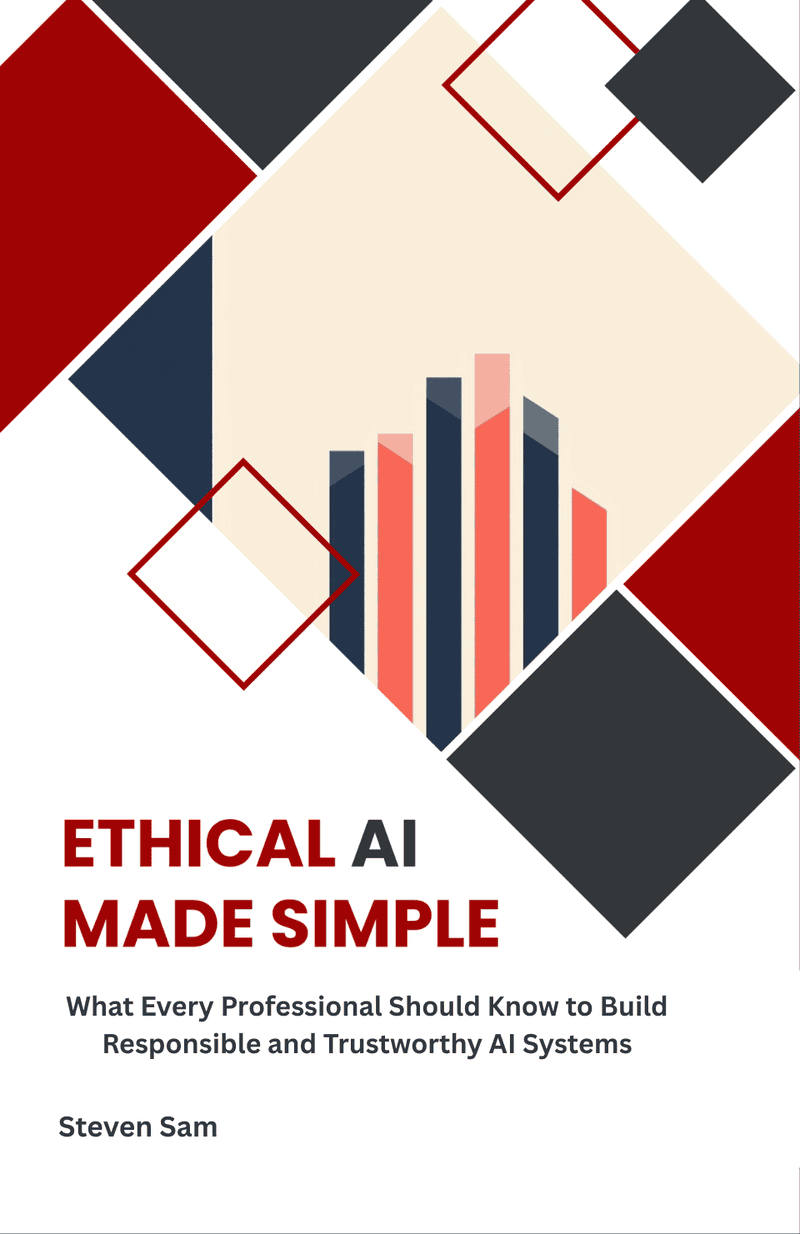
Ethical AI Made Simple.
What every professional should know to build responsible and trustworthy AI systems — a practical field guide for developers, product managers, and business leaders.
“Most AI failures are not caused by bad actors. They’re caused by professionals who never had a framework for thinking ethically about the systems they build.”
Every day, AI systems make decisions that affect real people’s lives — who gets hired, who gets a loan, who gets flagged, who gets seen. Ethical AI Made Simple is a practical field guide for developers, product managers, and business leaders who want to close the gap between good intentions and responsible outcomes.
Built around five core principles: fairness, transparency, privacy, accountability, and inclusivity, the book delivers role-specific guidance, seven real-world case studies, six professional simulations, and ready-to-use governance tools.
No philosophy degree required. Just a willingness to ask better questions. The future of AI depends on the people who build it responsibly, starting with you.
A complete map from principle to practice
Nine chapters, moving from foundational concepts to hands-on tools you can use this week.
A Note to the Reader
Why this book exists, and who it’s for.
The Stakes Have Never Been Higher
Introduction — the gap this book bridges.
What Is Ethical AI?
Definitions, myths, and the Three-Lens thinking framework.
The Five Pillars of Responsible AI
Fairness, transparency, privacy, accountability, inclusivity.
AI Gone Wrong
Seven documented real-world case studies, and the patterns across them.
Building & Using AI Ethically
Role-specific guidance and checklists for engineers, PMs, and leaders.
Tools & Resources
Open-source tools, global frameworks, and operational templates.
Simulations & Situational Thinking
Six scenario-based exercises for teams to work through together.
Leading the Future of Ethical AI
Culture, regulation, and emerging challenges.
Your Role in the Future of Responsible AI
Closing synthesis and the compound effect of ethical practice.
Appendix: Quick Reference Guide
The five pillars at a glance, checklist, and glossary.
Chapter One — read it before you buy
The full opening chapter, unlocked. See exactly how the book thinks before you commit.
What Is Ethical AI?
Foundational concepts, common myths, and the lifecycle of ethical risk
Defining the Terms That Matter
Ask five professionals what “ethical AI” means and you might get five different answers. For some it is about preventing bias. For others it is about preserving privacy. To some it sounds like corporate fluff discussed in panels but ignored in product meetings. This ambiguity is itself a problem. If we cannot clearly define what we mean by “ethical AI,” we cannot build toward it.
At its core, ethical AI is the practice of designing, developing, and deploying artificial intelligence systems in ways that promote human values, reduce harm, and ensure fairness, transparency, accountability, and inclusivity. It is not a single feature or a compliance checklist. It is a mindset — a way of building and managing AI with foresight, responsibility, and humility.
| Term | Definition |
|---|---|
| Ethics | The study and application of moral principles guiding what we consider right or wrong. In AI, this means evaluating how systems affect human beings and whether those effects are justifiable. |
| Responsible AI | A framework for building and deploying AI in alignment with ethical principles, societal values, and legal obligations. |
| Fairness | Ensuring AI systems do not produce discriminatory outcomes based on protected characteristics such as race, gender, disability, or age. |
| Algorithmic Bias | Systematic, unfair discrimination in AI outputs resulting from prejudiced assumptions in training data, feature selection, or objective functions. |
Table 1.1 — Core definitions in ethical AI (abridged)
Why AI Is Not Neutral
AI systems are trained on data created by humans, selected by humans, interpreted by humans, and optimized based on human-defined goals. Every one of those steps introduces human judgment, and with it, human bias. A model trained on historical hiring data does not learn “who makes a good employee.” It learns “who was historically hired” — a category shaped by decades of discrimination, unequal access, and cultural assumptions. When deployed, it does not correct history. It perpetuates it, at scale and at speed, with the veneer of objectivity.
The Lifecycle of Ethical Risk
Ethical risks arise at every stage of an AI system’s lifecycle, from problem definition to retirement. Decisions made during data collection, feature selection, model training, testing, deployment, and ongoing monitoring can each introduce or amplify harms such as bias, discrimination, exclusion, and unfair outcomes.
| Stage | Where Risk Enters |
|---|---|
| Problem Definition | The framing encodes assumptions about whose needs matter and what success means. |
| Data Collection | Data reflects historical inequalities, gaps, and the biases of those who collected it. |
| Model Training | Optimization objectives encode value judgments that may conflict with fairness. |
| Deployment | Real-world contexts differ from controlled testing in ways that amplify harm. |
Table 1.2 — Ethical risks and interventions across the AI lifecycle (abridged)
The Ethical Lens: A Thinking Framework
You do not need a philosophy degree to spot ethical risk. You need better questions. Apply this three-lens test to any AI project decision to surface hidden ethical risk.
| Lens | The Core Question |
|---|---|
| Impact | Who is affected by this decision, and how deeply? |
| Fairness | Could this produce different outcomes for different groups, and are those differences justifiable? |
| Accountability | If this goes wrong, who is responsible, and is there a real pathway to correction? |
Table 1.4 — The three-lens ethical framework
…continue reading in the full book, including the complete Chapter Summary, the Five Pillars framework, and seven real-world case studies.
You’ve just read the opening of Chapter One. There are eight more.
Get the Full BookAvailable on Amazon
Bulk orders & corporate training
Equipping a whole team is more effective than equipping one person. Two ways to bring this into your organisation.
Buying for your team or event?
Discounted pricing is available for bulk orders of 10 or more copies — ideal for onboarding kits, leadership offsites, university courses, or conference giveaways.
Bring the framework in-house
Cendory Digital delivers workshops and training sessions built around the book’s frameworks tailored for engineering teams, product organisations, and executive leadership.